


For grocery retailers, keeping pace with retail technology means understanding which investments will actually deliver the greatest value for their shoppers. Shoppers surveyed say they favor grocery retailers that help them save time, save money and stay in control. New IGD research commissioned by Instacart, drawing on 5,000 shoppers, 40 accompanied shopping trips and retailer interviews across the UK, France, Germany, Spain and Italy, shows where to start.
According to the research, European grocery shoppers surveyed aren’t asking for more technology – they’re asking for less effort. The opportunity for retailers is not simply to add more technology to the journey, but instead, use it to remove the friction shoppers experience across planning, finding, choosing and paying. Read on for some of the key insights, or download the full report.
Make shopping easier, not simply smarter
Across the five countries surveyed, shoppers’ priorities are broadly consistent. Those surveyed rate the basics that make their grocery shop easier as the most important, including: freshness and getting the right products, finding the best value, locating products easily, controlling total spend, confidence in stock and access to relevant offers. More novelty capabilities like discovering new products and meal inspiration fall lower in the ranks.
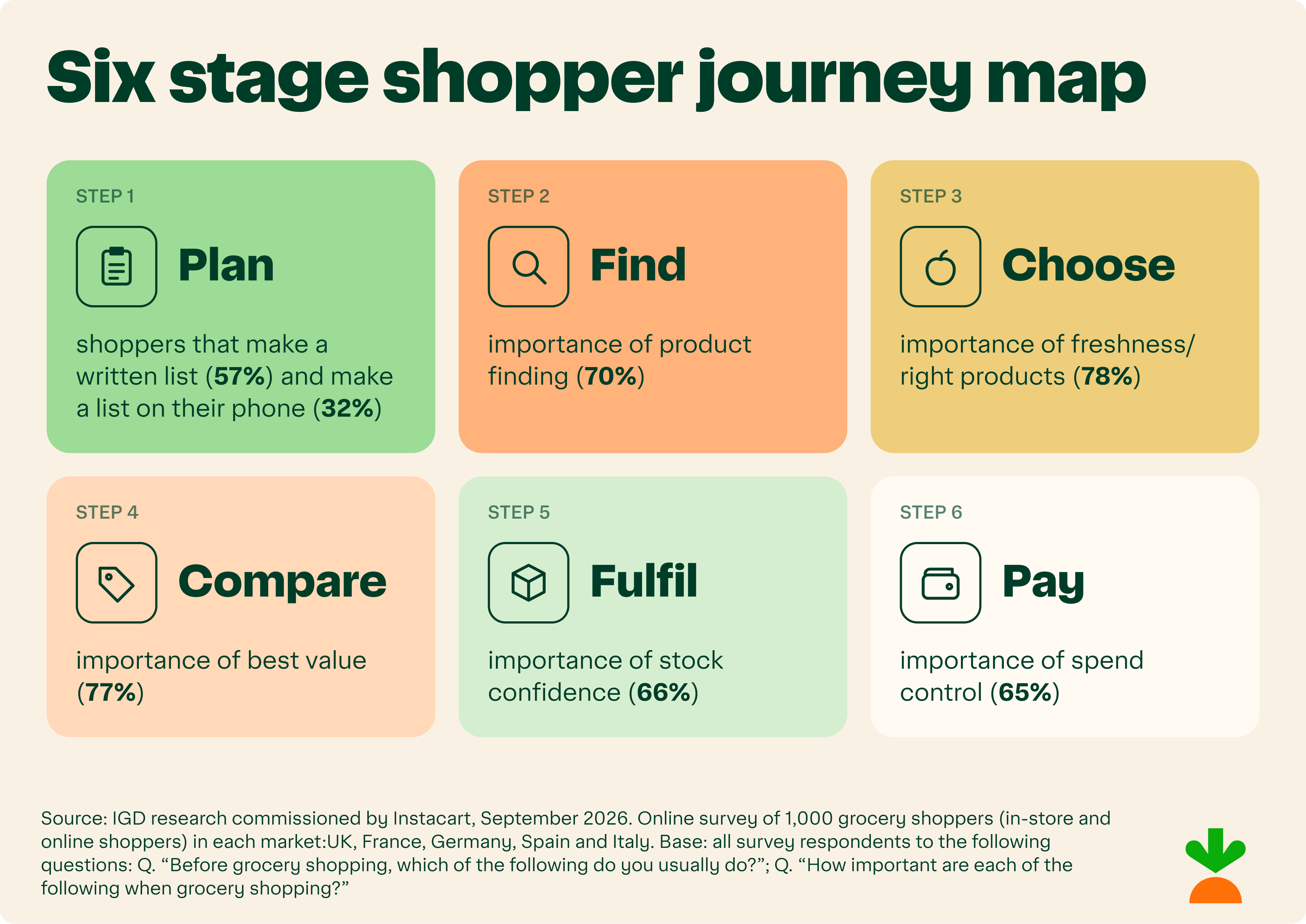
For the shoppers in this research, friction rarely sits in one isolated moment. It accumulates across planning, finding, choosing, comparing and paying. An unavailable product, a confusing offer or an unexpected intervention at checkout may each be manageable on its own; together, they can turn a routine shop into a frustrating experience. Checkout is the most cited in-store pain point. Online, where consumers can compare retailers and switch more easily, repeated challenges and annoyances may lead them to order less often or move their grocery spend elsewhere.
Personalise to save shoppers money, without taking control away
The shoppers surveyed are not rejecting personalisation or AI. They are defining the terms on which it works best: when technology saves money, saves time, remembers something useful or helps them compare credible options. Saving money is consistently the strongest use case for technology.
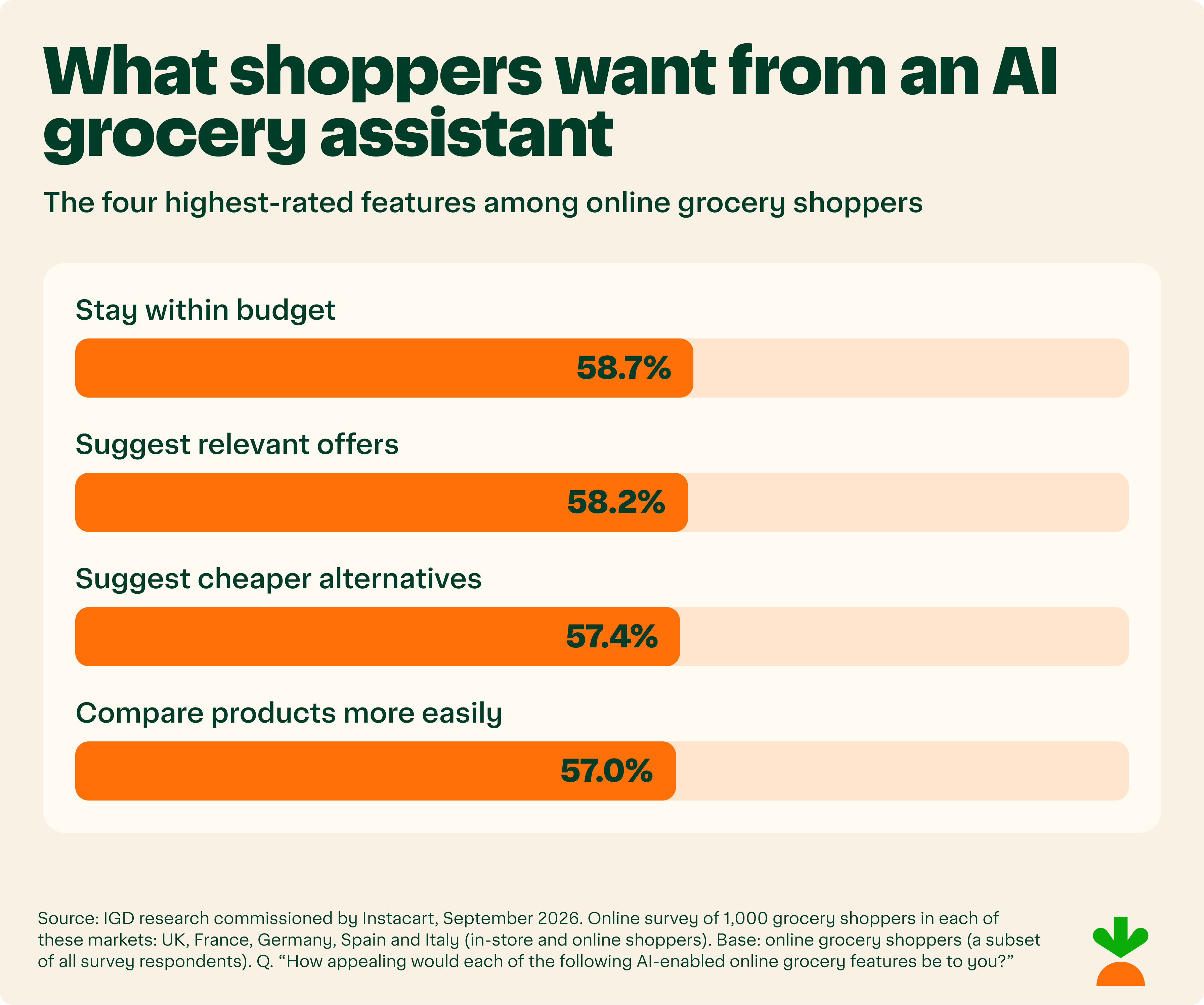
That shows up clearly in what online shoppers surveyed want from an AI grocery assistant on a retailer’s website or app. Around three in five say the most appealing features are those that help them stay within budget (58.7%), see relevant offers (58.2%), find cheaper alternatives (57.4%) and compare products more easily (57.0%). Reminders for forgotten essentials and substitution recommendations are a useful second layer, appealing to just over half of shoppers.
However, they still want the final say. Around four in five say they want to stay in charge of what they buy even when technology helps. As an example, automatically pre-filling a basket is the weakest proposition in every market (39.3%). As one French consumer put it: “I want AI to help me, but not do it for me.” Among those surveyed, current AI use is still limited and varies by age, so retailers need to demonstrate a clear, practical benefit first.
One set of needs, five market opportunities
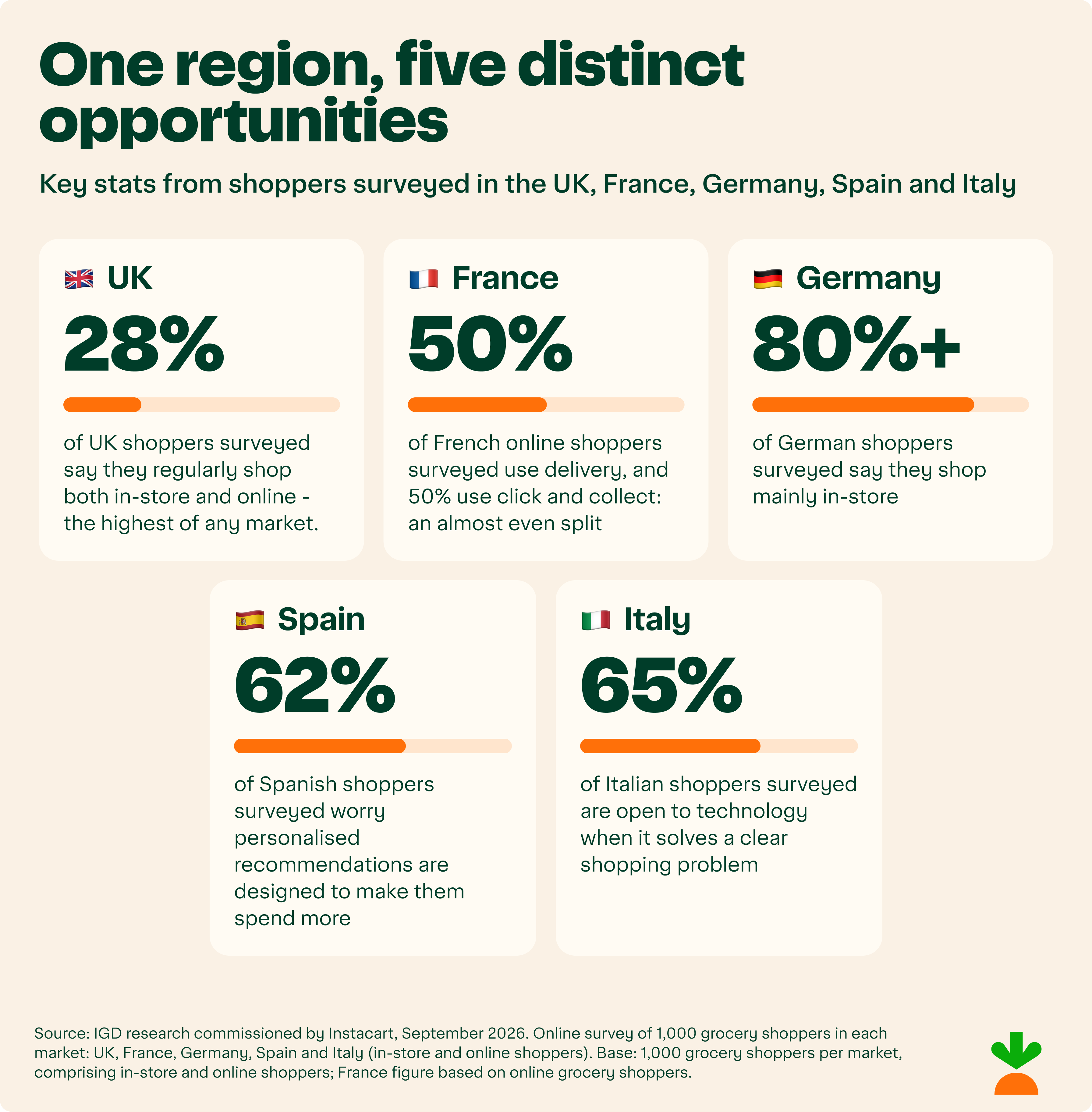
Shoppers surveyed in all five countries prioritise the same basics, but start from different places. The same feature can solve a different problem, depending on the mission and market.
UK: 28% of UK shoppers surveyed say they regularly shop both in-store and online, the highest omnichannel behavior of the five countries. The opportunity is connecting planning, shopping and payment.
France: French online shoppers surveyed are split almost evenly between delivery and click and collect. They also state a preference for light-touch help: “Not crossing that thin line between helping and telling you what to do.”
Germany: more than 80% of German shoppers surveyed say they shop mainly in-store, and time saving, organised routes and technical reliability come first.
Spain: Spanish shoppers surveyed show high interest in new tools, but 62% worry personalised recommendations are designed to make them spend more. Technology should clearly help shoppers save money and stay in control.
Italy: more than 80% of Italian shoppers surveyed say they shop mainly in-store, and 65% say they’re open to technology when it solves a clear shopping problem. They were also more likely than shoppers in other countries to say they’d change where they shop after a poor experience.
Fix, connect, innovate
The research points to a clear sequence for retailers: fix and connect, then innovate. Fix the basics that break trust first, especially availability, substitutions, fresh quality, search, promotions and checkout reliability. Advanced features will only create value if these basics work. Then connect information across channels, so lists, preferences, offers and purchase history move with the customer. Only then introduce new technology where the benefit is clear and the operation is ready.
As one Chief Technology Officer in Spain put it: “Use technology to solve the problems that you already know the user has.”
Make it easier, and the rest follows
Grocery shoppers will value retailers that help them save time, save money and stay in control. The research suggests that the winners will not be the retailers with the most technology, but rather those that deploy it most effectively to simplify the customer journey, strengthen trust at every touchpoint and deliver a more connected, consistent and personalised experience. The research shows where to start: fix the basics, connect the journey, then innovate where the benefit is clear. Instacart Enterprise brings together ecommerce, in-store technology and AI to help grocers do exactly that.
“We see an opportunity for retailers to turn a deeper understanding of shopper needs into technology investments that deliver meaningful value,” said Ryan Hamburger, Chief Commercial Officer at Instacart. “Our enterprise platform brings together ecommerce, in-store technology and AI to help grocers make more informed decisions, connect the shopping experience across channels and deliver greater value to their customers. Our goal is to help retailers understand where to focus and how to build AI platforms with confidence.”
Get the full report and retailer playbook
Download What European Shoppers Want from Grocery Technology for the complete findings, market-by-market detail and a practical playbook for what retailers should do next. Download the whitepaper →
Research commissioned by Instacart in partnership with IGD. Qualitative stage: accompanied in-store and online shopping journeys with 40 shoppers (8 per market), August–September 2026. Quantitative stage: a 15-minute survey of 1,000 shoppers in each of the UK, France, Germany, Spain and Italy (5,000 in total), September 2026. Eight qualitative interviews with retail representatives, August–September 2026.


